Peppol Explained
Peppol, originally an acronym for Pan-European Public Procurement Online, is a global network for exchanging standardised electronic business documents such as invoices, credit notes, and purchase orders. It was created in 2008 as an EU-funded pilot project to remove the complexity of cross-border electronic procurement in European public sector purchasing. Since 2012 it has been governed by OpenPeppol, a non-profit international association based in Brussels, which maintains the technical specifications, certifies service providers, and coordinates with national Peppol Authorities around the world.
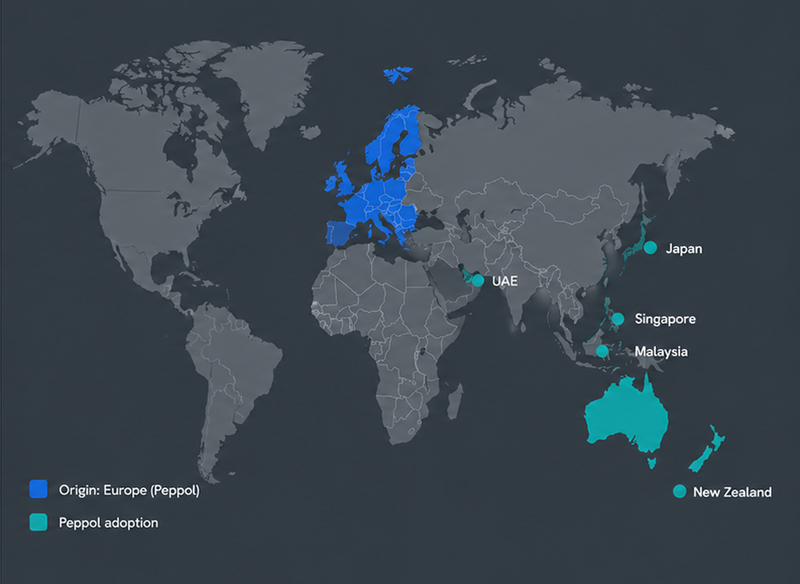
Although Peppol originated in Europe, its reach is now global. Countries including Australia, New Zealand, Singapore, Japan, Malaysia, and the UAE have adopted Peppol as their preferred or mandated e-invoicing infrastructure. This expansion is driven in large part by government e-invoicing mandates: an increasing number of jurisdictions require businesses to submit invoices electronically, and Peppol provides a ready-made, vendor-neutral network to do so. Within Europe, the EU's ViDA (VAT in the Digital Age) initiative has designated Peppol as the transport layer for cross-border B2B e-invoicing, further cementing its role as the de facto standard.
The Four-Corner Model
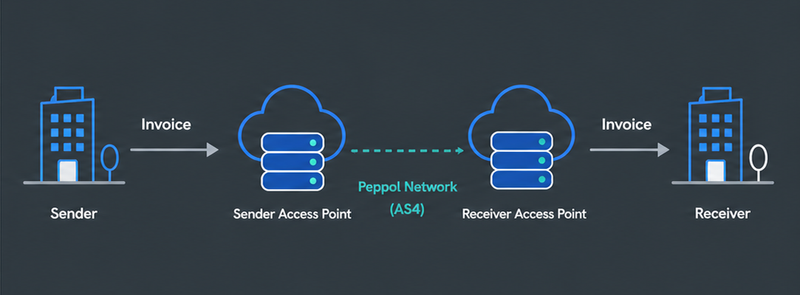
Peppol uses a "four-corner model" to move documents between trading partners. The model involves four parties: the Sender (Corner 1), the Sender's Access Point (Corner 2), the Receiver's Access Point (Corner 3), and the Receiver (Corner 4). The Sender is the business that creates and dispatches a document — for example, a supplier issuing an invoice. The Receiver is the business that ultimately consumes it.
The two Access Points in the middle are the crucial intermediaries. The Sender's Access Point accepts the document, looks up where to deliver it, and transmits it securely over the Peppol network. The Receiver's Access Point accepts the incoming document and makes it available to the Receiver. This means the Sender and Receiver never need a direct technical connection to each other. As long as both are connected through their respective Access Points, they can exchange documents with any other Peppol participant worldwide — regardless of which AP provider either party uses. The analogy often drawn is to email: you do not need to use the same email provider as the person you are writing to.
Access Points
An Access Point (AP) is the gateway through which a business connects to the Peppol network. Access Points handle the technical work: document validation, secure transmission using the AS4 messaging protocol, and participant discovery. A business can either operate its own Access Point (requiring certification by OpenPeppol) or use a commercial Access Point provider such as Arratech.
To become a certified Access Point, a provider must sign a formal agreement with a national Peppol Authority, pass a rigorous set of interoperability tests, and maintain valid Peppol PKI certificates. Certification ensures every Access Point conforms to the same technical standards — which is what makes universal interoperability possible. When a business chooses an AP provider, it is choosing how it connects to the network, but not limiting whom it can transact with.
SMP and Document Routing
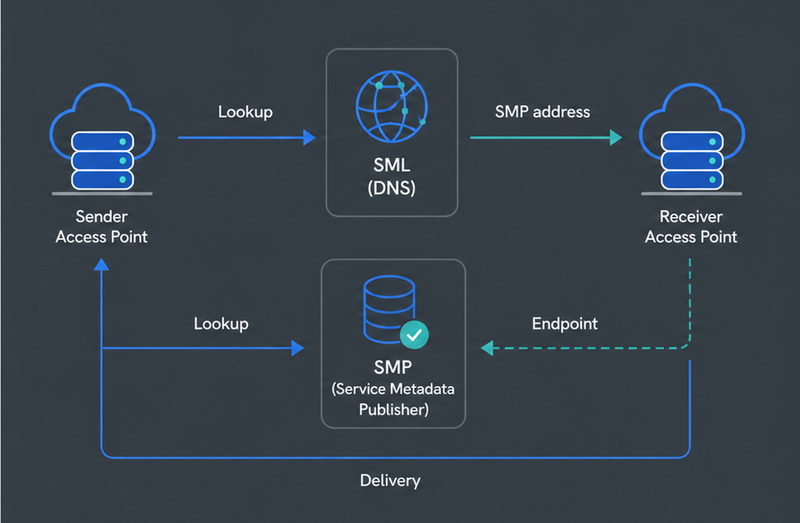
For a document to reach the right destination, the sending Access Point needs to discover which Access Point serves the intended receiver. This is handled by two components: the SML (Service Metadata Locator) and the SMP (Service Metadata Publisher).
The SML is a central DNS-based directory operated by OpenPeppol. When a sending AP needs to deliver a document, it performs a DNS lookup against the SML using the receiver's Peppol participant identifier. The SML responds with the address of the SMP where that receiver is registered. The SMP is a decentralised registry — each AP provider operates its own — storing which document types a participant can receive and the technical endpoint for delivery. The sending AP queries the SMP, retrieves the endpoint, and transmits the document. This two-step discovery (SML → SMP) happens automatically in real time, invisible to the businesses involved.
Document Standards: BIS and PINT
Peppol standardises both transport and the documents that travel over it. These standards are called BIS — Business Interoperability Specifications. The most widely used is BIS Billing 3.0, covering invoices and credit notes, built on EN 16931, the European semantic standard for electronic invoicing. Other BIS specifications cover purchase orders, order responses, catalogues, and despatch advice.
For use outside Europe, Peppol has developed PINT — the Peppol International Invoice model. PINT provides a jurisdiction-neutral base format that can be adapted with country-specific rules, with profiles already existing for Australia, New Zealand, Japan, Singapore, Malaysia, and the UAE.
Message Level Status (MLS)
MLS addresses a long-standing gap in Peppol: delivery confirmation. When a sending AP transmits a document, MLS allows the receiving AP to report back whether the document was successfully delivered to the end recipient, or whether delivery failed and why. This gives senders visibility into what happened after the document left their hands, essential for operational confidence and for tax-reporting workflows where proof of delivery matters.
The MLS response is itself a Peppol document.
The Five-Corner Model (C5) and Tax Reporting
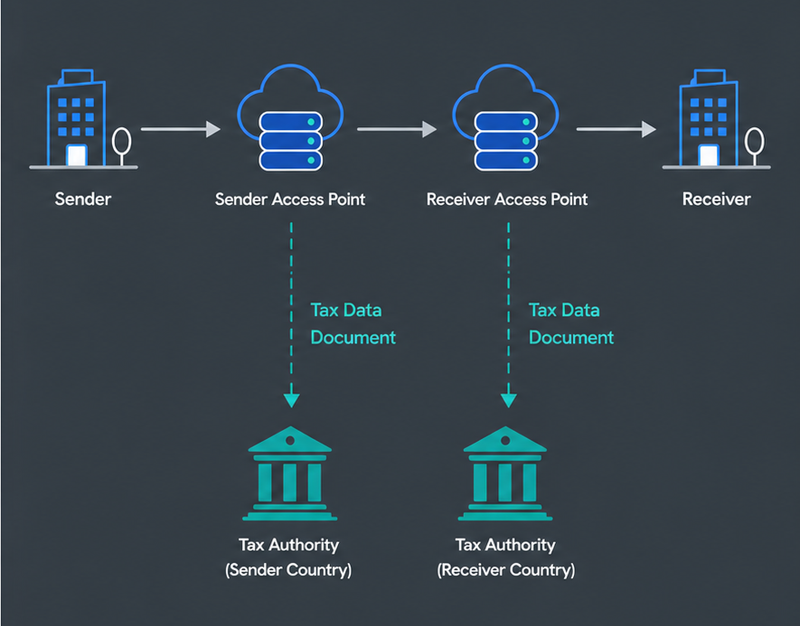
The EU's ViDA directive introduces Continuous Transaction Controls — near-real-time reporting of invoice data to national tax authorities. To support this, Peppol has extended its four-corner model with a fifth corner (C5), representing a Tax Authority Access Point. When an invoice is sent in a ViDA-enabled jurisdiction, the Access Points simultaneously transmit a Tax Data Document to the relevant tax authority, in parallel with normal invoice delivery. France and Italy are early adopters, with broader EU rollout expected over the coming years.
Tax Data Document (TDD)
The Tax Data Document is the specific Peppol document type designed for the five-corner model. It carries only the tax-relevant fields from an invoice — parties, tax categories, monetary totals — and is sent by the Access Point to the tax authority's endpoint on the Peppol network. TDD represents the mechanism by which Peppol evolves from a pure B2B network into one that also serves government tax-reporting requirements.